Image source:
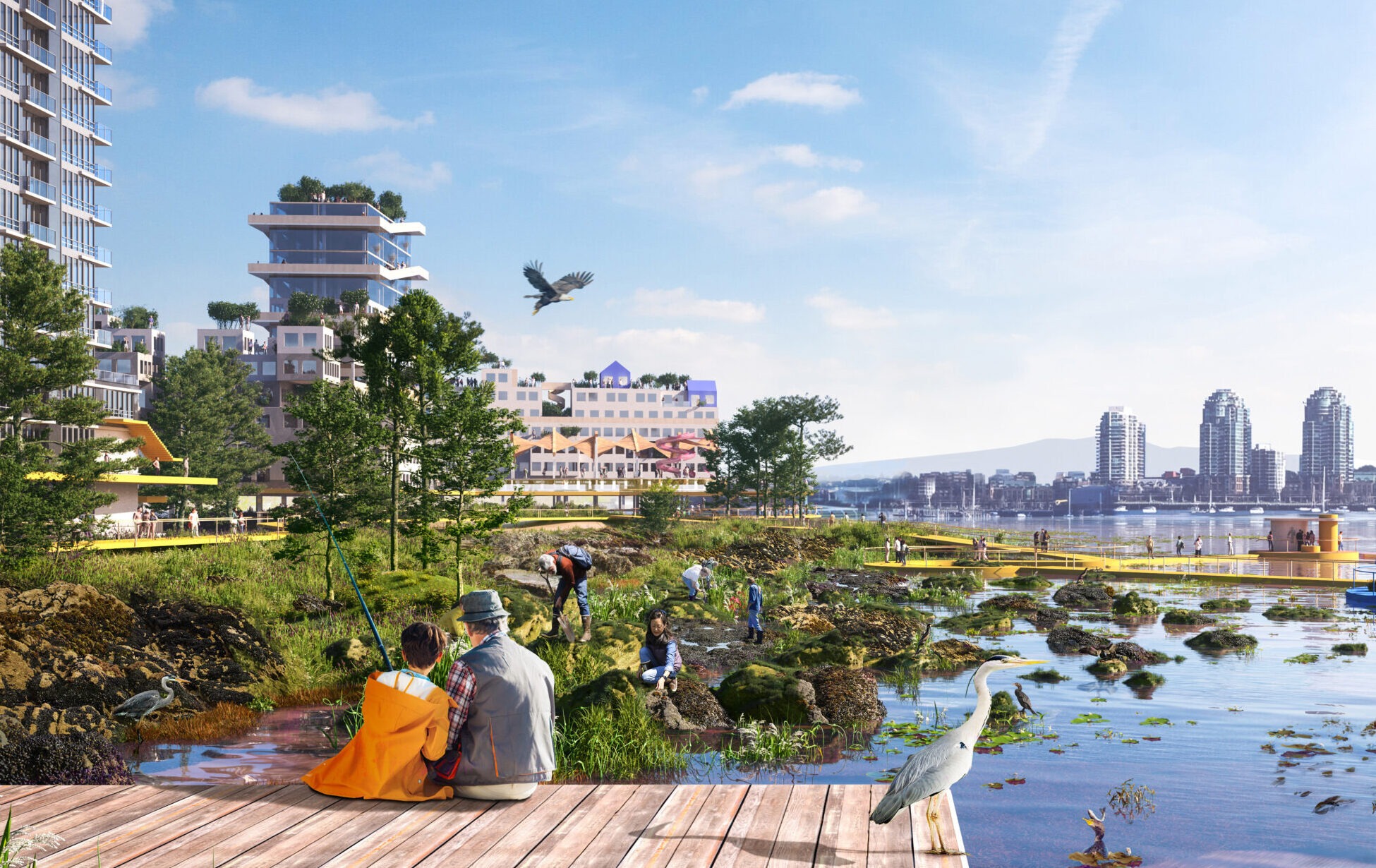
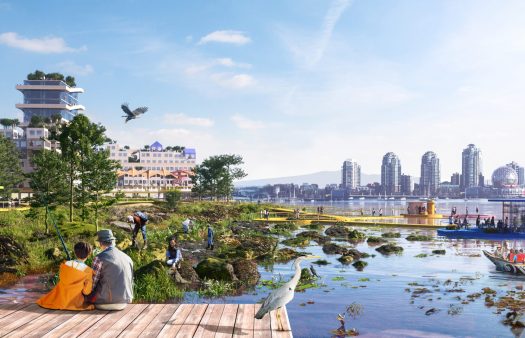
1-Sea2City Coopers Park, Vancouver
Managing Coastal Flooding
Flood hazard modelling that began in 2012 indicates that Vancouver, a coastal city, needs to be prepared for a 50 cm rise in sea levels by 2050 and 100 cm by 2100, in addition to storm surges and more extreme rainfall events as a result of human-induced climate change. The City is aiming to prepare for the changing climate with an equity lens that combines community values with technical criteria and solutions drawn from nature as well as traditional grey infrastructure such as concrete.
“Vancouver is a coastal city that has had little experience with major coastal flooding in a settler time period so we have very little flood management infrastructure,” explained Angela Danyluk, the Manager of the Climate Change Adaptation and Equity team in the Planning Department with the City of Vancouver. “Using a risk-based approach, we have been thinking about how we can make the city more resilient to rising sea levels and an increasing flood risk in a way that protects people, buildings, infrastructure and the natural environment.”
“We plan to use a variety of adaptation options to manage coastal flooding,” Danyluk said. “We will use a mix of grey infrastructure such as dikes and nature-based solutions to manage exposure to rising water levels and reduce erosion. We will also use non-structural tactics such as planning policies and by-laws to manage where and how high buildings can be built. We will also look to preserve the space needed along shorelines to build flood management infrastructure and apply nature-based solutions well into the future.”
Bringing Equity in Coastal Flood Management
When an equity lens is applied to coastal flood management, it involves prioritizing where the work is done and how the work will be done. In 2018 and 2020, Vancouver’s Planning and Engineering Departments initiated a comprehensive planning process for coastal flood management for the Fraser River and False Creek. The City’s goal was to manage coastal flooding in a way that produced many benefits for the community.
“Traditionally, coastal flooding is managed by teams led by engineers who usually apply a hard infrastructure approach that results in grey infrastructure such as dikes,” explained Danyluk. “In Vancouver, we wanted to approach this process differently. We wanted the pilot project to be evaluated using the seven values-based criteria that were identified by community engagement, as well as technical criteria. Those values-based criteria included factors related to safety, housing, Indigenous perspectives, recreational opportunities, transportation, culture, and environmental benefits.”
“We wanted a new approach that fostered open discussions about the trade-offs associated with different designs,” said Danyluk. “We also wanted to allow room for the process to be informed by the lived experience of those participating.”
Sea2City Design Challenge
One step in this process was a pilot project called the Sea2City Design Challenge. This project, which ran from September 2021 to September 2022, was developed to inform the next phase of the City’s Climate Change Adaptation Plan and the City’s coastal adaptation work. It employed an approach that aimed to restore relationships with the Host First Nations, rebuild connections to the Salish Sea, and employ a “two-eyed way of seeing”, which recognizes and integrates the strengths of both Indigenous and Western ways of knowing.
Two design teams participated in the Sea2City Design Challenge. Each one was led by a Designer rather than an Engineer and both teams were supported by a Cultural Advisor. The Sea2City Design Challenge included:
- a 28-member City Advisory Team composed of City staff and representatives and knowledge keepers from the Host First Nations – the Musqueam, Squamish, and Tsleil-Waututh peoples;
- a 21-member Technical Advisory Committee composed of experts from local consulting firms, academia, non-governmental organizations, and asset operators such as BC Hydro and Metro Vancouver;
- a 17-member Community Advisory Group with residents representing various perspectives from local communities; and
- a 15-member Youth Adaptation Lab.
One of the key recommendations from the process relates to the language used by the City when addressing coastal erosion. It was recommended that the language be changed away from “resist, accommodate, and move/avoid” which was seen as colonial language that “sees the water as separate and distinct from the land”. It was suggested that the language be changed to “acknowledge, host, and restore” to recognize water as “part of a larger, interconnected, and holistic system”.
The Sea2City Design Challenge report defines this new coastal language as:
- Acknowledge: spaces are retrofitted or relocated over time to improve their resilience and better care for and steward natural systems.
- Host: a dynamic place where water, nature, and culture are welcomed and stewarded. Human uses are flexible, adaptable, and leave a light-touch. Infrastructure works with nature to enhance resilience.
- Restore: a revitalized and rehabilitated shoreline that restores natural functions, features, and ecosystems, and includes improved flood protection for upland communities.
Outcome from an Equity-based Approach
The Cooper Tidal Terrace will be the first pilot project to move forward from the Sea2City Design Challenge. Construction will begin early in 2026 as part of a larger bridge seismic rehab project and end early in 2027.
“With this stretch of shoreline, a traditional, flat concrete sea wall will be replaced with a terraced design. The crest of the terrace will be raised to mitigate flooding. The terrace will be constructed with two tiers of pre-cast concrete. The outside walls will be textured to encourage sea life, such as seaweed and invertebrates, to attach to the surface. Inside the terrace will be native plants, shrubs and logs that provide habitat for pollinators and birds. The plants were reviewed by Host Nations plant knowledge keepers in this area,” said Danyluk. “The terrace will include inter-tidal habitat and provide pedestrians with access to enjoy and explore the waterfront. We will also be looking for ways to acknowledge and celebrate the Host First Nations language.”
Lessons Learned
The City has had a Sustainability Group for over 15 years. In 2022, it reorganized and repurposed an existing branch to focus on climate adaptation and equity.
“It is useful to have a team of staff who have the time to plan, problem solve, and project manage climate change adaptation projects in collaboration with other departments,” offered Danyluk. “Our group is also tasked with securing the funds for pilot projects such as the Coopers Tidal Terrace project.”
The Sea2City Design Challenge became “a collective learning and capacity-building opportunity for the City, project partners, and design teams” about a “more decolonialized planning approach” to coastal management, offered Danyluk.
This project is carried out with funding from the Federation of Canadian Municipalities’ Green Municipal Fund
and the Government of Canada.