Food Forests in Fredericton increase Climate Resiliency

CANUE | Food Forests in Fredericton increase Climate Resiliencyfredericton

Text by Kim Perrotta

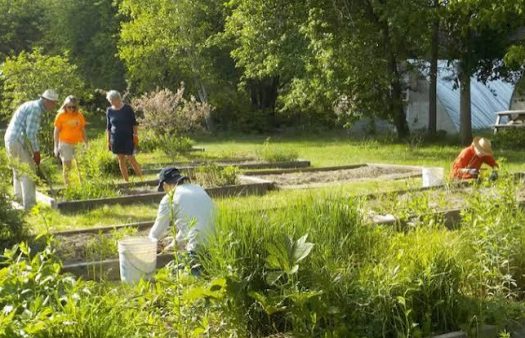
In 2025, the City of Fredericton initiated a new food forest pilot project in response to requests from the community. The goal is to plant fruit trees in parks for the use by the community. This program grew out of the City’s work on climate change adaptation and the development of its Urban Forest Management Strategy.  

Climate Change Adaptation Plan 

Human-induced climate change is increasing temperatures in summer and winter months and increasing the risk of drought, while also increasing the number and intensity of heavy rainfall, storms, flood events, and long lasting floods in the City of Fredericton in New Brunswick.  While the City is working to mitigate its greenhouse gases, it has also prepared a Climate Change Adaptation Plan to prepare for the changes in its climate that are now locked-in. Published in 2019, this plan identifies six goals: 

  1. Maintain Health and Safety
  2. Minimize Risk to Buildings and Properties 
  3. Strengthen Resilience of Core Built Municipal Infrastructure 
  4. Strengthen Resilience of Natural Infrastructure and Assets 
  5. Minimize Disruption to Municipal Services and Programs Offered 
  6. Create Partnerships and Empower the Community

Three of the recommendations included under these goals align with, and support, the food forest pilot project: 

  • Recommendation 1.4  – Whenever possible, maintain and continue to incorporate natural and constructed shade and/or cooling structures into public infrastructure and public spaces.
  • Recommendation 4.8 – Continue to integrate climate change adaptation considerations into City park plans and practices, including preserving biodiversity and ecology, the use of native species, water and shade features, adequate tree canopy and natural drainage features.
  • Recommendation 6.2 – Stay engaged with climate change work happening through the actions of individuals, groups and businesses in our community.

“We are in the process of renewing our climate change adaptation plan now,” offered Jillian Hudgins, Environmental Strategist & Program Manager for the City of Fredericton. “Flooding and extreme heat are real concerns in our community so issues related to trees, green space and parks are hot topics with our residents, as is food security.”

Urban Forest Management Strategy

To meet goal #4 in the Climate Change Adaptation Plan, Strengthen Resilience of Natural Infrastructure and Assets, the City conducted an assessment of its urban and rural forest, consulted with the public, and developed an Urban Forest Management Strategy.  This strategy applies to “all trees within the geographic City of Fredericton including street trees, forests, private lands, parks, and natural areas”.  

The City has a very high tree canopy cover compared to other cities across Canada.  For canopy heights greater than 2 metres, Fredericton has an average tree canopy coverage of 63.4% with 44.2% in its urban area and 69.6% in its rural areas.   Its urban tree canopy is much higher than Toronto’s (28%), Vancouver’s (23%), Montreal’s (20%) and Calgary’s (8%). The City is committed to maintaining that coverage and building the resiliency of its forest to the impacts of climate change, introduced and existing pests, and development pressures by increasing its tree-planting goal to 750-1000 trees/year and diversifying the tree species across the community.  

Folding Equity into the Forest Strategy

The assessment conducted for the forest strategy included the development of a socioeconomic index using Canadian census dissemination areas (     DAs).  Median values for the DAs were calculated for several factors including education level and annual income.  The populations in the DAs that had higher education and income levels than the median were deemed to be less vulnerable to extreme heat, while the populations in the DAs that had education and income levels lower than the median were considered to have higher vulnerability to extreme heat. These socioeconomic data sets were then overlaid with data for mean and peak summer temperatures to identify the      DAs that have both exposure to higher summer temperatures and populations that are more susceptible to harm from higher temperatures.  It was recommended that the occurrence of these factors  be one factor that is considered when prioritizing future tree planting and the protection of existing trees.

“Planting trees in the neighbourhoods that are home to the newcomers in our City is really important,” offered Rich Hall, City Forester with the City of Fredericton. “A lot of the newcomers to our City live in high density neighbourhoods and don’t have backyards so they make really good use of our parks for barbecues and family outings in the summer months.  We want to make sure that the parks in their neighbourhoods have shade and other amenities that make them cool and comfortable places for residents in these neighbourhoods.”  

Public Engagement Led to Food Forest

Public engagement for the City’s Urban Forest Management Strategy involved one open house, written submissions, and on-line engagement which included interactive mapping, video content, and the draft report.   Some of the submissions highlighted ideas that were not proposed by staff.  One of those ideas was the planting of fruit trees or food forests in the City’s parks.  This idea was raised several times from individual residents as well as by resident groups.  So, a recommendation was added to the strategy to select a park and plant fruit trees as a pilot project.  

“We picked a park, Wilmot Park, for our pilot project.  It is used a lot for summer camps and is located close to a multi-cultural community centre” explained Victoria Cray, Forest Technician with the City of Fredericton.  “We purchased 30 fruit trees.  We selected five different species – cherry, apple, peach, plum and mulberry.  And we planted them with partner plants that will deter pests, and with plants that can be used as herbs or as medicinal plants, and with plants that support pollinators”.

“Last summer was our first summer with the food forest pilot project so it is too early to tell how this is going to work out,” explained Hall.  “It is going to take 5-8 years before we have any fruit from our trees but people seem really excited about the project already.  Staff have already noticed that people are using herbs and the other plants that have been planted with the trees.”

“The food forest pilot project has so many co-benefits,” noted Hudgins.  “In time, the trees will provide shade and fruit in an underserviced neighbourhood that experiences higher temperatures and some food insecurity.  But already the process of planting the trees, herbs and flowers in this park has helped to build a sense of community in that neighbourhood. Social cohesion is an important element in climate resiliency; one that can save peoples’ lives in an extreme heat event.”  


 This project is carried out with funding from the Federation of Canadian Municipalities’ Green Municipal Fund
and the Government of Canada.
CANUE | Food Forests in Fredericton increase Climate Resiliencylogo fcm eng

Peterborough’s Rain Gardens for Private Property

Text by Kim Perrotta

Background

In July 2004, the City of Peterborough was flooded when 9.5 inches of rain fell in a single day and overwhelmed the city’s storm water and sewer systems.  The fire department, utility and social services were inundated with calls.  One hundred and seventy-one people had to be evacuated from a long-term care facility.  Flooding resulted in 28 vehicle collisions and trapped 25 people in or on their cars.   Basements were flooding.  Electric meters and gas lines had to be disconnected.  And water heaters were damaged. Over a thousand residents needed emergency food and clothing.

The 2004 flood made it clear that we needed a more robust stormwater management system in the city,” explained Curtis Mei, Acting Manager, Water Resources, Asset Management and Capital Planning with the City of  Peterborough. “It was the motivation behind the development of the 2005 City of Peterborough Flood Reduction Master Plan which laid the groundwork for the city’s work in this area.

Evolution of Stormwater Management

There has been a learning process in the stormwater management field,” offered Mei.  “At first, cities worked to capture stormwater in grey infrastructure that delivered the water to a nearby body of water.  But that system delivered a lot of pollution picked up from roads and pavement such as dog waste, fertilizer, and vehicle leaks and emissions, directly into our watercourses.” 

“Then it was thought that we should direct storm water to man-made settling ponds where the pollutants were captured, but those settling ponds have to be dredged which is a costly undertaking” Mei continued. “So now, cities work to control run-off at the source so that water can be filtered through the soil on the site where it falls.”  

“Recognizing that we need to manage the water that falls on private property as well as public property, the City’s Stormwater Quality Master Plan that was completed in 2011 recommended the establishment of a program for rain gardens on private property,” said Mei.

What is a  Rain Garden?

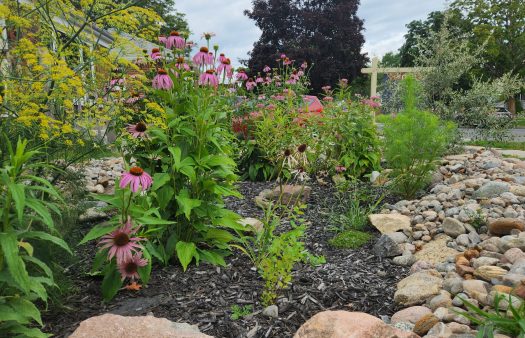
A rain garden is a bowl-shaped garden that collects and absorbs the rain and melted snow that runs off impervious surfaces such as rooftops on a property,” offered Laura Keresztesi, the Coordinator, Neighbourhood & Residential Programs with GreenUP, a local environmental non-governmental organization.  “It is designed to have a shallow depression that is 20 to 30 centimeters deep.  It is planted with native species that have deep root systems that help absorb and naturally filter stormwater on site.  The bowl should hold water for up to 24 hours; it is not a water garden. The bowl of the garden should be planted with species that can tolerate ‘wet feet’. The top of the berms can be planted with drought tolerant species.  Choosing the right plants for each zone of the rain garden can help reduce maintenance as the garden matures.”

Rain gardens can remove 90% of the chemical pollutants and 80% of the sediment from stormwater runoff.  They also allow 30% more of the water that falls on a property to soak into the ground than regular grass lawns.

How does the Rain Garden Program Work?

The rain garden program began in 2020 with a collaboration between the City’s Water Resources team and GreenUP.

“Our goal is to encourage residents to incorporate rain gardens into their properties while promoting greater awareness of stormwater management and community involvement,” said Mei. “Rain gardens play an important role in reducing urban runoff from private lands, filtering pollutants from surface water, and replenishing groundwater supplies. They also enhance local biodiversity by attracting butterflies, dragonflies, and other beneficial insects, as well as native bird species.” 

“The first few years of the program, we ran a number of workshops to educate people about how to design, install and maintain a rain garden,” said Keresztesi. “We found it was difficult for people to arrange their schedules around workshops so we developed instructional videos that are now available 24-7 on our website so people can access them at their convenience. Through our partnership with the City, we also offer onsite consultations and support people with their applications and installations”.

Each year, both organizations advertise the program with ads and social media.  GreenUP will also leaflet neighbourhoods.  Residents can get a one-time subsidy up to $1000 to help them establish their rain gardens.  The funds, which can be used to cover the cost of plants or to help prepare the garden, can be claimed with receipts once the project is completed.   

The City has hired GreenUP to make the program as friction-free and accessible as possible.  GreenUP answers calls from residents, distributes intake forms, conducts on-site consultations, and provides technical advice about the design of the garden and the plants that can be used.

Over the 5 years that the program has been in place, GreenUP has had direct communication with over 1500 people and assisted with the establishment of about 24 rain gardens on private properties. 

Challenges and Lessons Learned

“There has been a lot of interest in the rain garden program from residents but only a handful move forward with one each year,” noted Keresztesi.  “Those who do move forward are quite committed to the idea of having a naturalized yard that supports biodiversity.”  

“Funding does not seem to be the barrier for residents,” offered Keresztesi. “Some residents cannot install a rain garden on their property because they do not have enough space.  For others, the rain garden is part of a larger landscaping vision and other things need to happen first before the rain garden can be installed.  For many, the barrier may simply be having the time and energy to dig, shape and plant.” 

“We do allow residents to use the program funding for landscaper related costs to conduct the work,” offered Mei.  “We try to make it easy for people to claim the funds from the program.”  

“We have made the subsidy program available to community centres and schools.  While we have received inquiries from these organizations, there have not yet been any rain gardens installed on these properties.” said Keresztesi. “In some cases, the property was not eligible for the program, and in other cases, I think the teachers simply did not have the capacity to lead the project on top of everything else they are responsible for.”

“Currently the reduction of water volume to the storm water system has not been significant; that would require widespread implementation,” noted Mei.  “But the program has been very effective at educating the public about  stormwater management and the benefits of capturing water on site.  It helps them to understand the work the City is doing to prevent future floods, improve water quality in local rivers, and replenish ground water.”   


 This project is carried out with funding from the Federation of Canadian Municipalities’ Green Municipal Fund
and the Government of Canada.
CANUE | Peterborough’s Rain Gardens for Private Propertylogo fcm eng