Image source: City of Montreal – Jonathan Bélisle
Text by Kim Perrotta
Montreal’s Climate Change Plan
Adopted in December 2020, Montreal’s Climate Change Plan 2020-2030 was developed with a commitment to making the city greener, fairer, more resilient, and carbon neutral. The plan was designed to meet the city’s new climate target “to reduce its greenhouse gas (GHG) emissions by 55% by 2030” and to enable the Montreal community to reinforce the city’s climate resilience. The 52 measures in the Climate Plan will set Montreal on the path to being a resilient, inclusive and carbon-neutral city.
This plan is consistent with the Montreal strategic Plan, Montreal 2030, which is guided by four key goals:
- accelerating the ecological transition;
- reinforcing solidarity, equity and inclusion;
- amplifying democracy and participation; and
- stimulating innovation and creativity.
Nature-Based Goals and Indicators for Climate Resilience
In order to increase resilience to climate hazards such as heat waves, heavy rain, and destructive storms, the climate plan commits the city to “increasing protected natural areas and the resilience of urban forests, reducing heat islands, restoring the riverbanks and favouring the development of healthy and dynamic urban agriculture”.
The plan includes eight indicators that are to be monitored and reported on annually. Four of those are dedicated to the city’s climate adaptation:
- “The number of trees planted by the city and its partners with priority given to vulnerable areas to heat waves with the goal of planting 500,000 trees by 2030;
- The area of land to be protected as a natural area or natural environments that contribute to biodiversity with the goal of increasing that area to 10%;
- The status of climate hazards with the goal to decrease overall vulnerability; and
- The area of heat islands with the goal to decrease that area.”
All of these indicators are pertinent to extreme heat and the heat resilience of the City of Montreal, although some have goals related to biodiversity, flooding and other climate-related events.
Nature-Based Interventions: Increasing the Ratio of Greenspace
“The climate plan identifies several nature-based solutions that can increase the heat resiliency of the city,” said Claudia Atomei, Planning Consultant with the Adaptation, Resilience and Biodiversity Division in the Office of Ecological Transition and Resilience with the City of Montreal. “First, Action 17.1 aims to develop the necessary means to curb the use of impermeable artificial surfaces such as pavement and concrete, particularly through urban planning and regulations. Montreal’s Land Use and Mobility Plan aims to increase the ratio of greenspace from 38% at present to 40% by 2050. This will help reduce temperatures while increasing the absorption of water from rain and snow.”
“This may not sound like an ambitious target, but it is when you consider how much development will happen across the city over the next 25 years and the fact that Montreal is situated on an island with hard boundaries for growth,” noted Rachel Mallet, Research Geomatic Analyst on Climate Change Adaptation, in the Adaptation, Resilience and Biodiversity Division with the City of Montreal.
“This action will require mapping the physical properties of surface materials across the Agglomeration of Montreal for their reflectivity and heat storage capacity,” Mallet noted. “We want to map these surfaces so we can evaluate the vulnerability of different neighbourhoods to heat waves and monitor our progress over time.”
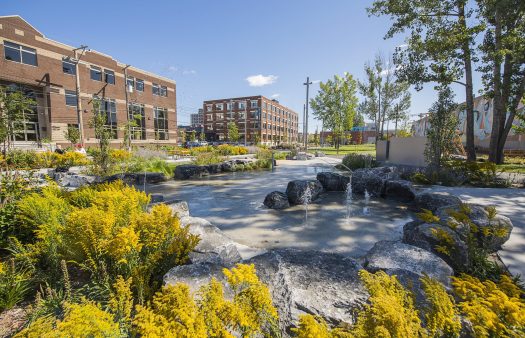
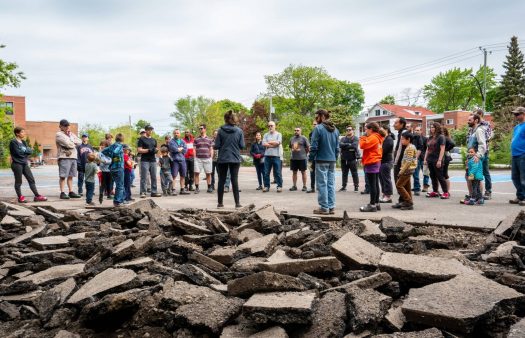
“Second, Action 17.2 in the climate plan aims to increase green spaces in vulnerable and priority areas in the city by promoting the removal of pavement and concrete on streets and lots surrounding schools, low-rent housing, and seniors’ residences,” said Mallet.
Nature-Based Interventions: Increasing Tree Canopy within Vulnerable Areas
A third action in the climate plan, Action 20, requires the City and its partners to plant, maintain and protect 500,000 trees in neighbourhoods vulnerable to heat waves between 2020 and 2030. It aims to reduce indoor and outdoor air temperatures to protect people, while also decreasing energy costs, air pollution, noise levels, and the risk of flooding.
The trees are to be planted on public and private property. The City has set aside funds in its Ten-Year Capital Expenditures Program to reach 50% of this target and expects the private sector and senior levels of government to provide the rest.
The trees are to be selected for their climate resilience and with an eye to encouraging biodiversity. Policies are to be developed to prioritize the planting of trees in the neighbourhoods that are most vulnerable to heat waves. The city is supporting the boroughs by identifying potential planting sites, including sites that need to be de-paved, which are very often located in urban heat islands.
Nature-Based Intervention: Other Actions that Increase Heat Resiliency
The climate plan includes several other actions that are directed at increasing biodiversity or flood resiliency that will also improve the city’s heat resiliency:
- Action 19 commits the City to increase the proportion of protected natural areas and areas that contribute to biodiversity from 6.1% to 10%. To achieve this goal, the City is creating new parks and green corridors that connect natural spaces. The primary goal of this action is to support wildlife movement and the dispersion of plants but it will also cool neighbourhoods.
- Action 19.2 aims to optimize the ecological contribution of municipal green spaces in ways that support biodiversity such as reducing mowing frequency.
- Action 21 commits the city to restoring the public riverbanks in the large parks network and will add green and blue spaces in the city that can help reduce air temperatures.
“We are working to naturalize the city’s greenspaces,” said Atomei. “We are promoting the replacement of tightly-trimmed green grass with indigenous mature plants that have deeper roots, absorb more water, and support a more diverse mix of insects, birds, and mammals. This type of vegetation also has a greater cooling effect on air temperatures, especially during night-time.”
“Montreal is also committed to becoming a ‘Sponge City’ that has parks, streets, and boulevards that use vegetation and containment systems to absorb and capture rainfall and snow melt,” offered Atomei. “While these surfaces and structures are designed to manage stormwater, reduce flooding, and improve water quality, they will also help cool air temperatures.”
Assessing Climate-Related Risks and Tracking Progress
The climate plan commits the city to develop a decision-making tool to analyze the land across the Montreal Urban Agglomeration for its vulnerability to climate-related impacts. This analysis, which has been integrated into the 2050 Land Use and Mobility Plan, helps to identify the areas most vulnerable to extreme events. It is also used to monitor progress using the indicators identified above.
“I have been tasked with the job of developing tools that can be used to identify vulnerable neighbourhoods that should be prioritized for action to protect people at greatest risk of harm from climate-related events,” explained Mallet. “The index for greening, for example, is based on data related to urban heat islands, the tree canopy index, areas vulnerable to heat for health reasons such as age, neighbourhoods that are vulnerable to harm for socioeconomic reasons, and living environments where people live or congregate. The Large Parks, Mont Royal, and Sports Department use it, among other things, to adjust their program for creating and enlarging designated areas for planting trees”.
Assessing the Efficacy of Climate Resiliency Measures
The vulnerability index is also used to assess the urban planning policies and interventions that can be used to protect people from extreme events such as heat.
“Our Division is assessing various climate resiliency interventions for their efficacy under different circumstances,” said Mallet. “For extreme heat, this includes the gathering of existing data and the collection of data that is missing such as surface and air temperatures in local areas, to analyse how well various resiliency measures reduce surface and air temperatures, decrease the area of urban heat islands, or reduce the exposure of residents.”
“When it comes to heat, these assessments will likely be directed at interventions that have been employed in the boroughs such as white roof by-laws and green laneways, as well as those that have been employed by other jurisdictions,” added Mallet. “This will be particularly important for priority neighbourhoods where tree planting is not feasible because of space constraints.”
✅ Montreal Governance Structure
The City of Montreal and 15 reconstituted cities are part of the Montreal Urban Agglomeration which provides common services such as water treatment, waste management, and policing for the whole region. The City of Montreal, which is composed of 19 boroughs, has a population of approximately 1.7 million people. The central office in Montreal provides data, policy support, and funding to the boroughs, but the boroughs can and do develop and implement programs and policies independent of the central office.
This project is carried out with funding from the Federation of Canadian Municipalities’ Green Municipal Fund
and the Government of Canada.